Exploring Victorian India in Empire Veil
British India as a Game World
Two of Empire Veil’s three campaigns take players through the regions of British India, making the subcontinent the game’s richest and most detailed setting. The Shadow Over the Colony campaign is set entirely within India, while The Crimson Telegraph begins in Calcutta before spanning the globe. Each Indian region offers distinct gameplay characteristics, historical atmosphere, and women’s networks to engage.
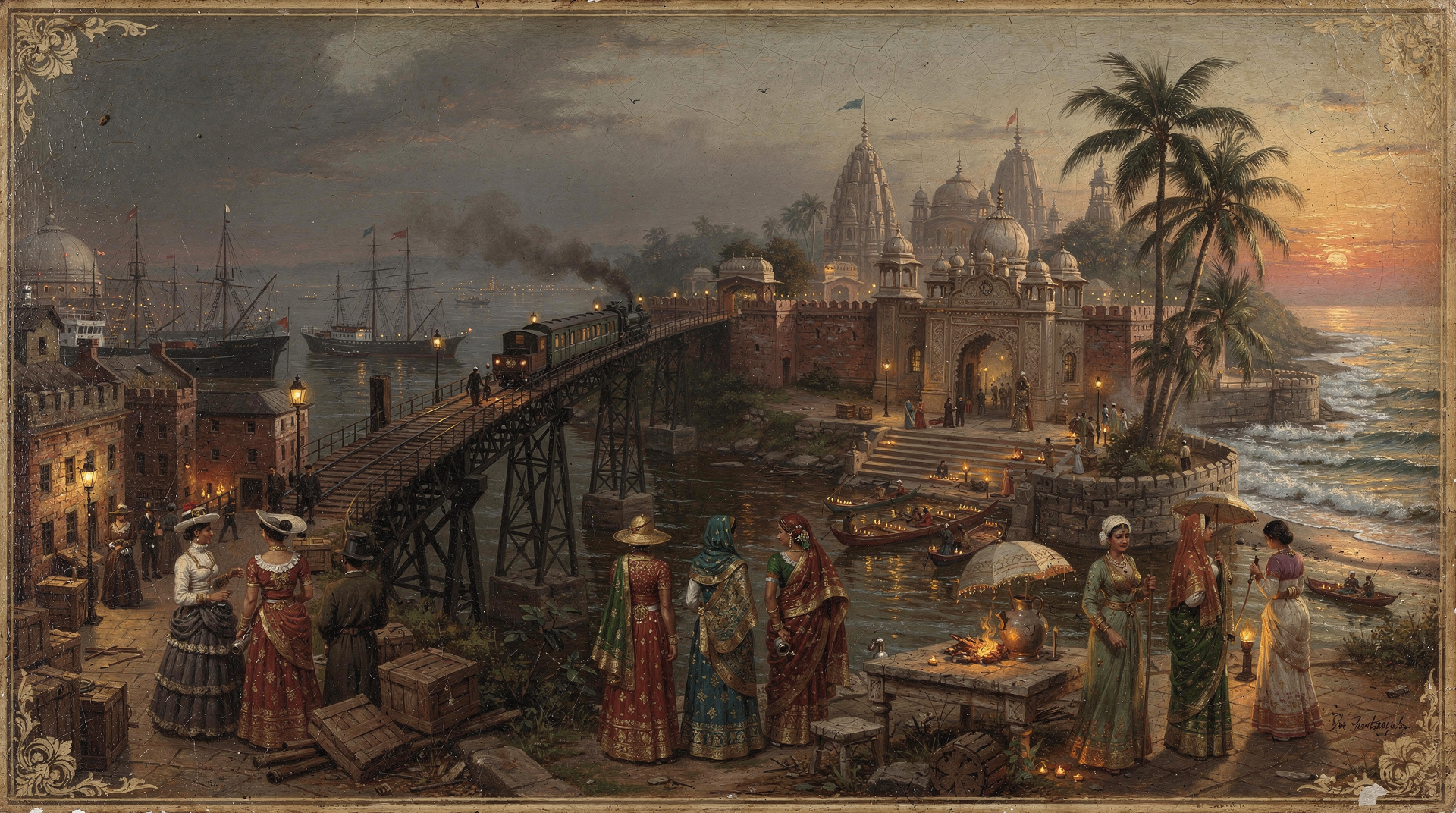
Calcutta: Capital of the Raj
Calcutta serves as the starting point for most investigations in India. As the capital of British India, it is a city of contradictions — colonial splendour alongside ancient mystery, European architecture shadowing labyrinthine bazaars.
The city is divided into four districts:
The Docks are a busy harbour where ships from across the Empire arrive. Intelligence flows with the cargo, and the dockworkers’ families see who comes and goes. The Memsahib Network is strong here, as officers’ wives track their husbands’ shipping manifests.
The Grand Bazaar is a labyrinthine marketplace filled with exotic goods and whispered secrets. In gameplay terms, the bazaar offers high-risk, high-reward investigation opportunities — clues come easily, but so does Menace from the watchful eyes of Veil agents.
The Colonial Quarter is the administrative heart of British India. Here, the Hostess’s social connections shine. Colonial wives maintain the social calendar, and every dinner party is an intelligence operation in disguise.
The Temple District contains ancient temples where old traditions still hold sway. The temple women here guard knowledge passed down through centuries. Accessing their wisdom requires Trust and patience, but yields clues unavailable through any official channel.
Benares: City of the Sacred
Benares (modern-day Varanasi) is the spiritual heart of India in Empire Veil. The city of a thousand temples, where the Ganges carries both salvation and secrets.
In the Shadow Over the Colony campaign, Benares holds crucial artifacts and knowledge that The Veil desperately seeks. The widows of Benares are a unique gameplay element: women who have lost everything and therefore have nothing to fear. In Benares, all lady investigators gain a bonus to Observation tests, because the widows share everything they have witnessed.
The Widow’s Watch special rule reflects a historical reality. Widows in Hindu society were often marginalised, but their very invisibility gave them an unusual vantage point. In Empire Veil, this becomes a strategic advantage — the women society forgot are the ones who see the most.
Delhi: Seat of Empires
Delhi carries the weight of multiple empires. Mughal palaces stand alongside British administrative buildings, and the city’s women navigate between worlds.
In gameplay, Delhi presents a unique challenge: the road route from Calcutta to Delhi is long and hazardous, while the rail connection through Benares is safer but adds an extra stop. This makes Delhi a strategic destination that requires planning to reach efficiently.
The Mughal princesses and their descendants in Delhi represent a distinct knowledge network. Their family histories predate the British by centuries, and their understanding of power, intrigue, and hidden wealth is unmatched. In the Shadow Over the Colony campaign, Delhi’s women hold essential clues about artifacts that male colonial scholars cannot locate.
Madras: The First English Fortress
Madras (modern-day Chennai) is the oldest British settlement in India, anchored by Fort St. George — the first English fortress on the subcontinent. The city connects Calcutta to southern India via a sea route, making it a key node in the game’s transport network.
Madras plays a particular role in the Shadow Over the Colony campaign, where one of the three required artifacts is hidden in the region. The temple women and devadasis of Madras hold oral traditions dating back millennia. The Spiritualist’s communion with temple women at this location grants significant bonuses to Occult tests.
The Indian Transport Network
Travel across India is itself a strategic element. Three transport modes connect the Indian regions:
Rail links Calcutta to Benares to Delhi to Madras in a chain. It is fast (1 action cost) with moderate hazard chance. The expanding railway network of the 1880s is both a tool for the investigators and a target for The Veil.
Sea connects Calcutta directly to Madras, bypassing the inland regions. It costs 2 actions but offers a way to move quickly between the coasts.
Road provides a direct but dangerous route from Calcutta to Delhi. At 3 actions and elevated hazard chance, it is a desperate option — but sometimes desperation is the only option.
Playing the India Campaigns
For players tackling the Indian campaigns, a few strategic considerations emerge:
Build Trust early. India’s women’s networks — the zenana, the temple women, the widows — all require Trust to access. Invest in Trust-building actions in your first few turns, and the networks will reward you throughout the campaign.
Do not neglect Benares. The Widow’s Watch bonus and the city’s spiritual significance make it a powerful base of operations. Even in The Crimson Telegraph, starting your Indian investigation from Benares can yield faster progress than diving straight into Calcutta’s crowds.
Respect the dark rituals. In Shadow Over the Colony, being alone in a region triggers ritual encounters. Travel in pairs when possible, and use Temple Refuge strategically when you must split up.
The Indian regions of Empire Veil offer some of the game’s richest storytelling and most challenging tactical decisions. They reward players who take the time to build relationships with the women’s networks — because in India, as across the Empire, the sisterhood remembers.