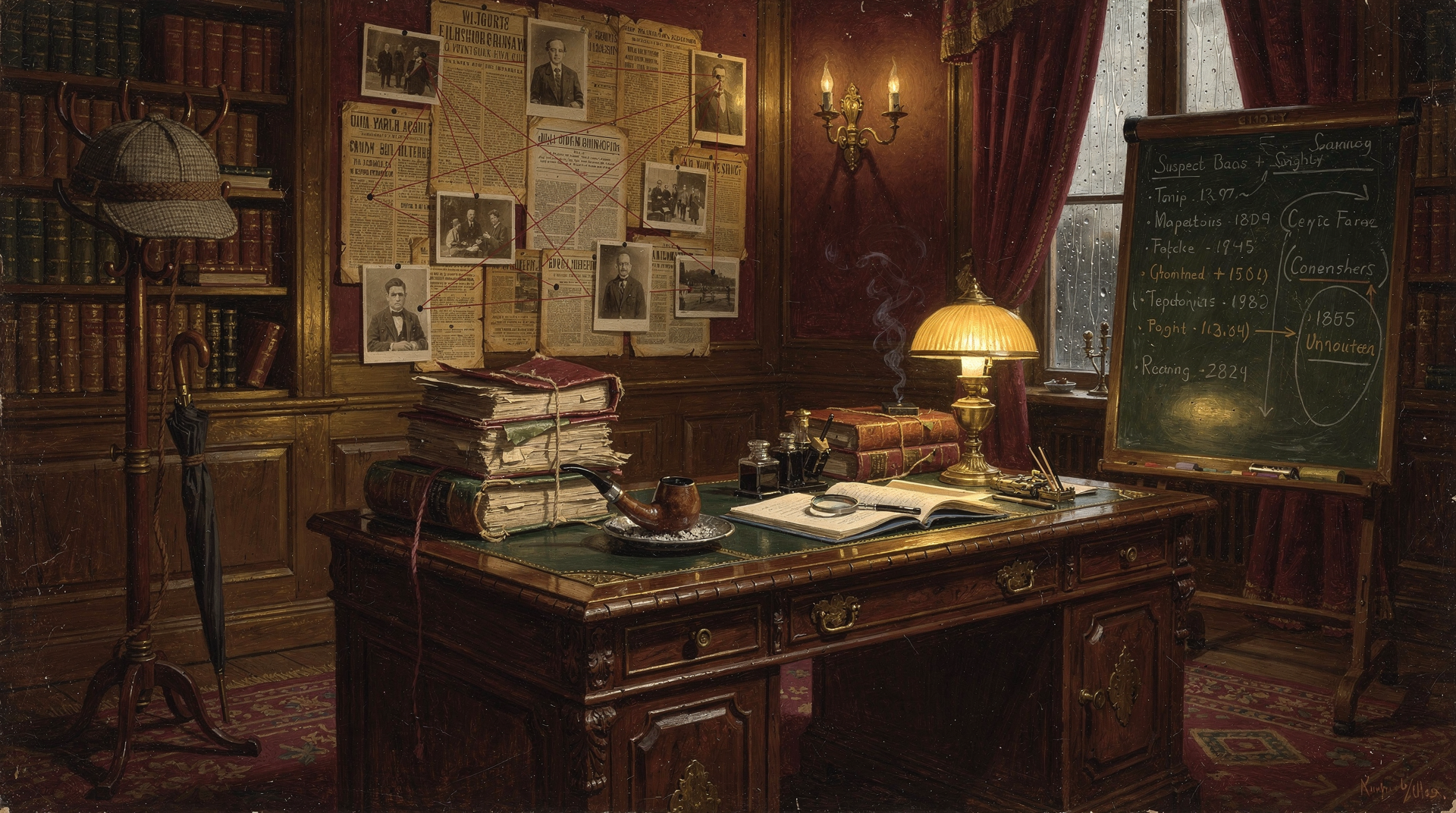
Victorian Detective Board Games: A Comprehensive Guide
The Enduring Appeal of Victorian Mysteries
The Victorian era has long captivated board game designers and players alike. Fog-shrouded London streets, the rise of modern forensics, a rigid class system hiding dark secrets — it is the perfect setting for games of deduction and investigation. From parlour room mysteries to globe-spanning conspiracies, Victorian detective board games offer some of the richest narrative experiences in tabletop gaming.
Classic Titles That Defined the Genre
Sherlock Holmes: Consulting Detective
First published in 1981, this landmark game set the standard for narrative detective games. Players read case booklets and visit locations across London, trying to solve mysteries with fewer leads than the great detective himself. Its emphasis on reading comprehension and deductive reasoning over dice rolls created a genre unto itself.
Letters from Whitechapel
A tense asymmetric game where one player takes the role of Jack the Ripper while others play the investigating police. The cat-and-mouse dynamic across a historically accurate East End map makes this a favourite for groups who enjoy psychological tension. Its one-versus-many structure offers a very different dynamic from cooperative detective games.
Mystery of the Abbey
Set in a medieval monastery rather than Victorian London, this deduction game nonetheless shares the genre’s DNA. Players move through the abbey, question suspects, and use process of elimination to identify the murderer among the monks. It blends Cluedo-style deduction with a richly thematic setting.
Modern Victorian Detective Games
Arkham Horror (and the Arkham Files)
While technically set in the 1920s, the Arkham Horror series draws heavily on Victorian gothic horror traditions. Players cooperate as investigators facing eldritch horrors, managing a tension between gathering clues and surviving cosmic threats. The character-driven narrative and cooperative mechanics influenced many subsequent designs.
Pandemic Legacy
Not strictly a detective game, but Pandemic Legacy’s legacy mechanics — where decisions permanently alter the game board and rules — revolutionised cooperative gaming. Many Victorian detective games, including Empire Veil, draw on its model of evolving narratives across multiple sessions.
Chronicles of Crime
This modern hybrid game uses a companion app and QR codes to create an investigative experience. Players scan locations, characters, and evidence to piece together cases. While it uses technology rather than paper, it carries forward the Victorian detective genre’s core loop of investigation and deduction.
Empire Veil: A Fresh Perspective on the Victorian Mystery
Empire Veil enters this genre with several distinctive features that set it apart from its predecessors.
Women at the Centre
Most Victorian detective games cast players as male investigators — detectives, police inspectors, or gentlemen scholars. Empire Veil centres women as its protagonists: the lady investigators who use society connections, servant networks, and the bonds of sisterhood to uncover conspiracies. This is not merely an aesthetic choice; it fundamentally shapes gameplay through the women’s network mechanic, where different social circles of women provide intelligence through channels invisible to male authority figures.
A Global Scope
While many Victorian games confine themselves to London, Empire Veil spans the British Empire. Players investigate in Calcutta, Benares, Delhi, Madras, Alexandria, and London, with each region offering distinct gameplay characteristics, NPC networks, and thematic flavour. The transport system — spanning sea routes, railways, roads, and rivers — makes travel itself a strategic decision.
Cooperative with Hidden Information
Empire Veil blends cooperative play with a Trust mechanic that governs information sharing. Players work toward shared objectives but must spend Trust to share specific intelligence. This creates moments of genuine tension: do you reveal a crucial lead (spending precious Trust) or keep it hidden and hope the situation resolves itself?
Three Campaign Tiers
Rather than offering a single-difficulty experience, Empire Veil provides three campaigns at different complexity levels. The standard-difficulty Crimson Telegraph is accessible to newcomers, while the expert-level Whitechapel Horror challenges experienced players with time pressure and escalating danger. This tiered approach means the game grows with its players.
What to Look For in a Victorian Detective Game
When choosing a Victorian detective game, consider what appeals to you most:
- Narrative depth: Games like Sherlock Holmes: Consulting Detective and Empire Veil offer rich storytelling where the experience of reading and discussing is as important as the mechanical outcomes.
- Deduction mechanics: If you enjoy process-of-elimination reasoning, Mystery of the Abbey and classic Cluedo variants satisfy that itch.
- Cooperative tension: Empire Veil and Arkham Horror create shared stakes where every decision affects the entire team.
- Asymmetric play: Letters from Whitechapel appeals to groups who enjoy one player taking an opposing role.
- Replayability: Campaign-based games like Empire Veil and Pandemic Legacy offer evolving experiences across multiple sessions, while standalone cases like Sherlock Holmes are one-and-done affairs.
The Future of Victorian Detective Games
The Victorian detective genre continues to evolve. Digital integration, legacy mechanics, and diverse perspectives are expanding what these games can offer. Empire Veil represents a new wave that combines historical research with inclusive design, giving voice to the women whose contributions to the Victorian era have long been overlooked in popular culture. The sisterhood remembers — and it has stories to tell.