The Women Investigators of Empire Veil
Why Women Detectives?
The Victorian era is often remembered through the lens of great male detectives — Sherlock Holmes, Inspector Lestrade, Hercule Poirot. But the reality of Victorian-era investigation was more nuanced. Women occupied unique positions in society that gave them access to information men could never obtain. They managed household correspondence, maintained social networks that spanned continents, and moved through domestic spaces where secrets were kept and shared.
Empire Veil builds its entire gameplay around this historical insight. The lady investigators are not women playing at being men. They are women using the tools and networks that their position in Victorian society uniquely provides.
The Six Investigators
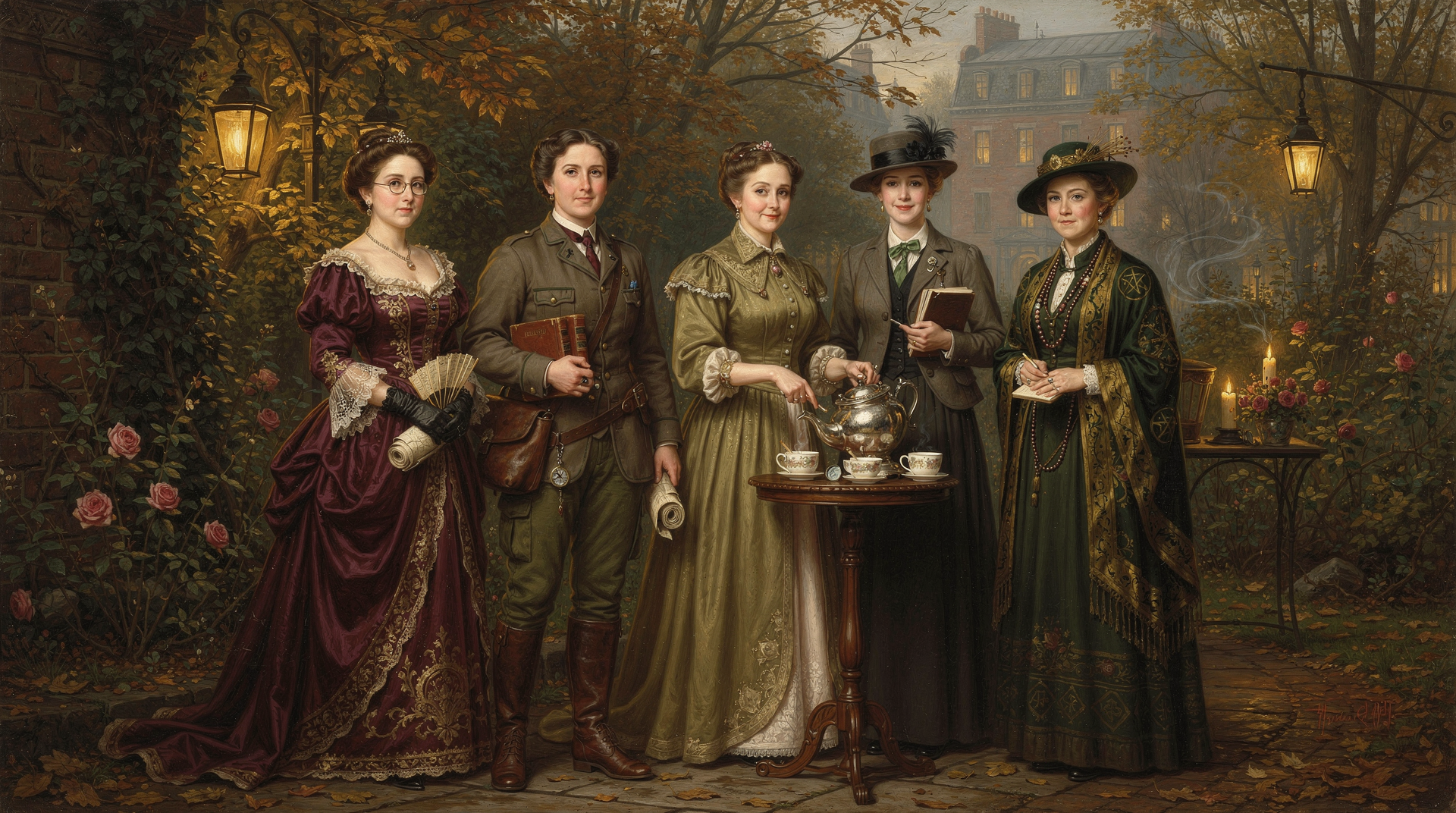
Each of Empire Veil’s six investigator roles reflects a real archetype of Victorian womanhood:
The Society Infiltrator represents the socialite whose presence at every ball, dinner party, and afternoon tea is unremarkable — and therefore invisible. She moves through the highest circles of power without raising suspicion, because no one expects a lady to be paying attention to anything more than fashion and gossip.
The Bluestocking draws from the tradition of self-educated Victorian women who pursued knowledge despite being barred from universities. Women like Ada Lovelace, Mary Somerville, and Florence Nightingale pushed the boundaries of what was considered acceptable feminine pursuit. In the game, the Bluestocking’s academic network and research skills are indispensable.
The Adventuress is inspired by real Victorian women travellers like Isabella Bird, Mary Kingsley, and Gertrude Bell, who explored territories that colonial administrators considered too dangerous for “the fairer sex.” Their physical courage and cultural adaptability make the Adventuress the team’s protector and problem-solver.
The Hostess wields the power of social capital. In Victorian society, the woman who managed a household’s social calendar controlled who met whom, what information was shared at dinner, and which alliances formed over afternoon tea. The game’s Hostess uses these connections to lower barriers for the entire team.
The Sob Sister takes her name from the real Victorian-era female journalists who covered sensational stories — often the only journalists willing to investigate crimes against women and the poor. In Empire Veil, her journalistic instincts accelerate clue gathering, though her public profile draws unwanted attention.
The Spiritualist reflects the Victorian fascination with the occult, séances, and communication with the spirit world. Many practicing mediums and spiritualists were women, and the movement gave them a rare platform for public authority. In the game, the Spiritualist’s otherworldly perceptions come at the cost of social standing.
The Women’s Networks
The game’s most distinctive mechanic is the women’s networks system. Across the British Empire, women from every social class form invisible channels of intelligence:
The Memsahib Network comprises the wives, sisters, and daughters of colonial officials. They manage correspondence, read every telegram, and maintain the social fabric of colonial life. They know more about what passes through their husbands’ offices than the officials themselves.
The Zenana Network spans the women’s quarters of India, where generations of knowledge — temple rituals, ancient texts, family histories predating the British by millennia — are preserved and shared. The zenana is invisible to colonial authorities but holds the deepest secrets of the subcontinent.
The Sisters’ Watch is a mutual protection network formed by working women in London’s East End. With no one else to rely on, these women — barmaids, washerwomen, dockworkers’ wives, charity workers — watch out for each other and remember every face, every threat, every stranger’s arrival.
The Temple Women guard sacred knowledge across India’s religious sites. Devadasis, widows of Benares, and scholars’ daughters hold oral traditions and sacred texts that no colonial academic has ever accessed.
Design Philosophy
Empire Veil’s focus on women investigators is not about creating a “women’s version” of a detective game. It is about recognising that the Victorian world was not solely shaped by the men who held official power. Women’s networks — formal and informal, from the drawing room to the zenana, from the charity ward to the dockside boarding house — were real conduits of information, influence, and mutual support.
By centring these networks as a core gameplay mechanic, Empire Veil offers something genuinely new to the detective board game genre. The Trust system, the network-versus-official investigation trade-off, and the role-specific abilities all flow from this central premise: the sisterhood sees everything.
Historical Grounding
The game draws on extensive research into Victorian-era women’s lives across the British Empire. The campaigns reference real historical contexts: the colonial telegraph system, temple traditions of India, and the social conditions of Whitechapel in the late 1880s. While Empire Veil is fiction, its world is built on the real contributions and experiences of women who history has too often overlooked.
As the game’s opening reminds players: “The Veil believes they control information. They do not know about us.”